
Trekking in the jungle is likely the most common activity for tourists in Ratanikiri province in Cambodia. We went on a two day, one night camping trekking experience in Ratanakiri recently, and in this article we’ll share with you our honest experience and what you should be prepared for.
Scroll to the end for the TL;DR
What we were told beforehand
We wanted to visit Ratanikiri because we were interested in seeing the gibbons in the nearby national park in Cambodia’s northeastern jungle. The gibbons in Cambodia are under threat from habitat loss, and several conservation initiatives have been set up in the country as a result, including in Veun Sai – Siem Pang National park which connects to Virachey National Park in Ratinikiri. It is possible to stay overnight at the conservation centre, where scientists and researchers have been following some of the gibbon families for years, and the possibility of a sighting is very high, at least 80%.
However, upon arrival in Ratinikiri, we were talked out of the experience due to the distance and cost (approximately $180 per person for one night). Instead, we were told there was another trek we could do nearby in Virachey National Park where we could also trek at dawn to try and spot the wild gibbons, which was $45 per person, per day ($90 each for a two day trek). We agreed to a two-day-one-night trek in the jungle and whilst the experience was in many ways incredible, there was a disconnect between the information we received beforehand from the tour company, and the experience we received in the jungle with the guides and rangers.
Our experience
Though we knew that we were going into wild jungle, that our guides may have to use machetes to cut through undergrowth and that we would camp in army-style hammocks, nothing had prepared us for quite how adventurous this trek would be!
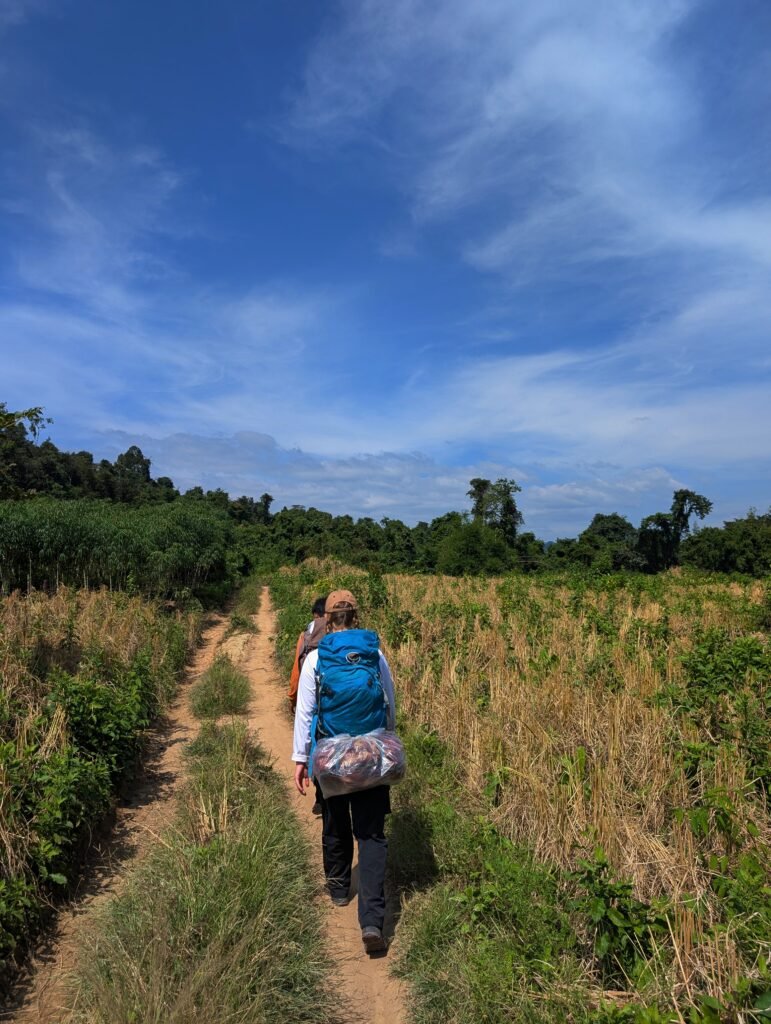
To begin with, the journey to the jungle is very long. Overall it takes around four hours to get from Ban Lung, the capital of the province and where the tours depart from, to the jungle’s edge. In our case, this included an hour and a half on a tuktuk, a short ferry to cross the river, an hour clinging to the back of a motorcycle driven by one of the talented guides/ rangers over dirt tracks that are more ditch than road and wooden bridges with large holes (bring your own helmet! You won’t be provided with one and we didn’t have one as we weren’t aware this was part of the journey), followed by an hour trek through rural farmland. We stopped before the trek to share out the provisions including two large bottles of water each and a hammock to strap to the rear of each person’s backpack.
The journey is scenic, and gives an incredible insight into areas of rural Cambodia many tourists don’t get the chance to experience, however, it is much longer than we were led to believe. With the journey being so long, we’d recommend you don’t plan to spend fewer than two nights in the jungle to make it worth it. With only one night, we felt we spent more time travelling than trekking.
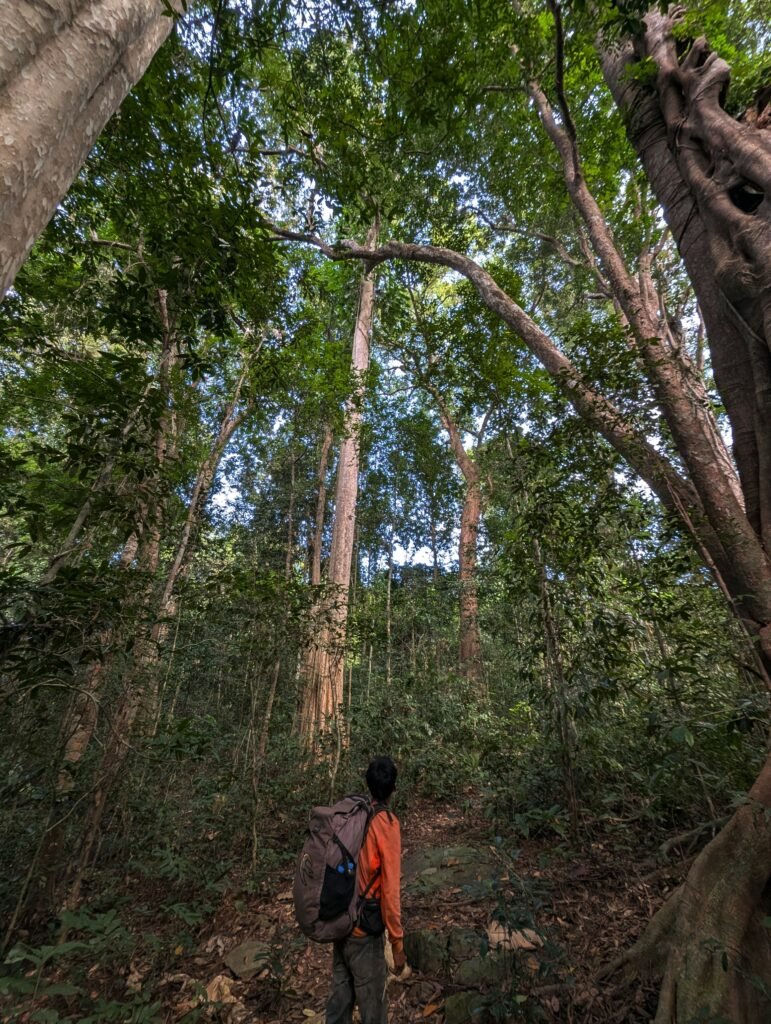
Once we reached the jungle, we crossed a creek by balancing on the rims of two small sunken boats, before boarding a (thankfully) still floating boat for a short journey along the Se San (also called Tonlé San) River. At last we were in the jungle, and began a stunning but sometimes challenging two to three hour trek through dense jungle. Our guides were fantastically knowledgeable, and showed us various plants and animals including some delicious edible leaves that tasted like crisp apples, and a plant that stored fresh, clean water you can drink right from the tree – and they did it all in flip flops! You do need to watch out for jungle insects and other nasties like giant ants and leeches, which in our experience were absolutely everywhere and can be quite painful if they get trapped in your sock, as happened to me.
We reached camp by a small stream with some gentle rapids by mid-afternoon and were offered to do another hour or two of trekking, which we decided not to do, as we’d been on the road since around 8am and were quite exhausted. We were shortly joined by another couple from a tour company run by the brother of the man who ran the company we went with. They were very friendly, and we spent the afternoon relaxing and chatting by the camp. Having great company really improved the experience, which is fun in a larger group.
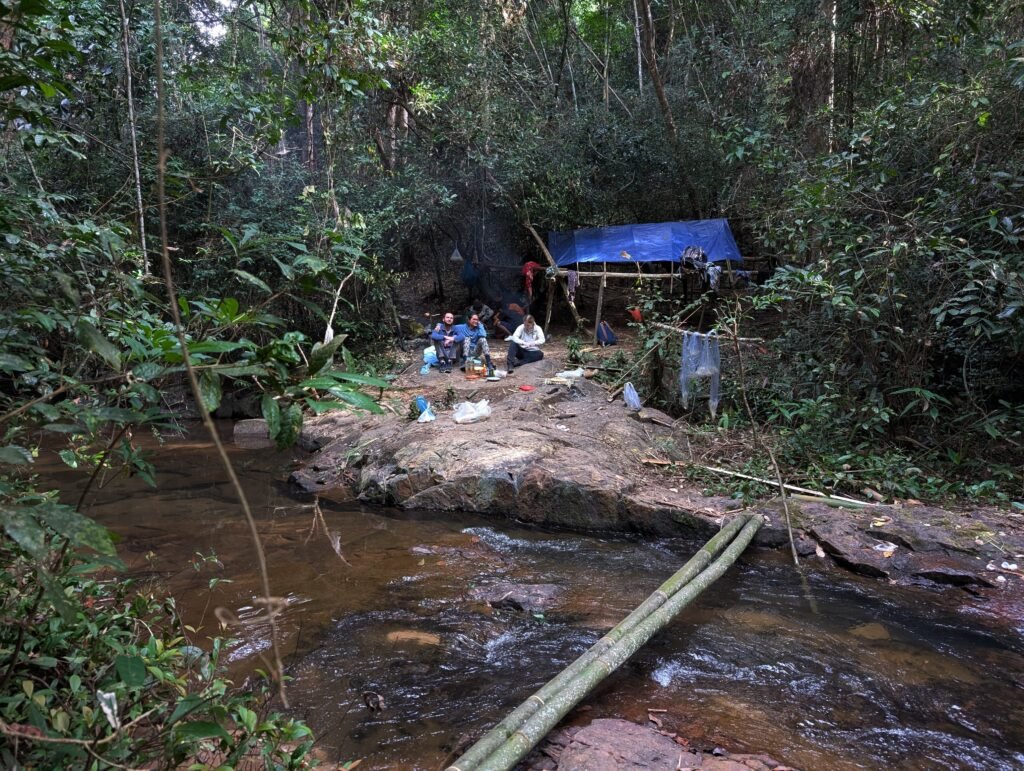
We would have happily helped set up camp and cook alongside the guides and rangers, but we seemed to be more in the way when trying to help than useful, and whilst the guides and rangers spoke enough English to get us through the jungle safely, we understand that language for instructing us to assist them are a different set of skills. Regardless, they have some unbelievable skills, including weaving a makeshift grill from bamboo, and using the natural environment to help with cooking.
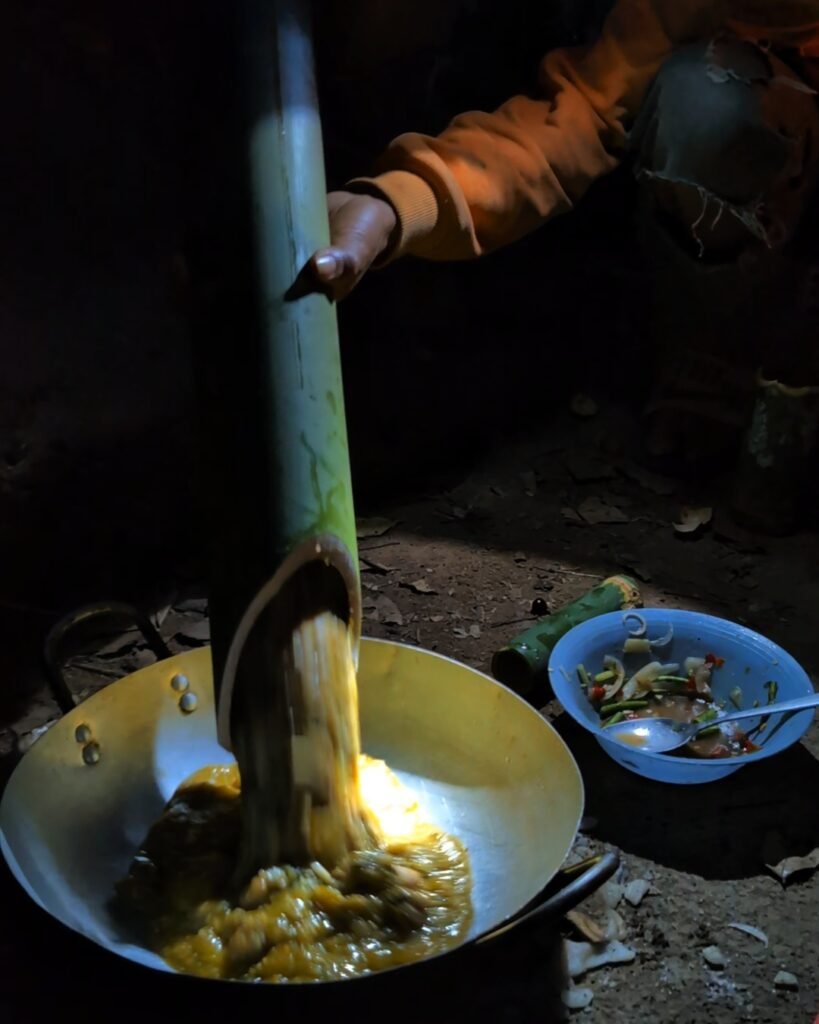
The rangers and guides made a fantastic dinner of a pickled spicy salad, rice, and bamboo soup (a coconut, pumpkin, meat and spices soup cooked inside a large tube of bamboo, cut from the jungle that evening and placed directly into the fire). We were a bit nervous, but the food was delicious, the guides could certainly have careers as cooks if they so wished, and we were told one was the village cook for big events!
We then had to get to bed in our hammocks which had been hung from a sturdy bamboo structure by the stream, as we were told we were getting up at 3:30am to begin to trek into the jungle to look for gibbons. We are not sure if by choice, or if the tour companies do not provide rangers and guides with good equipment, but some of them did not have mosquito nets or blankets in their hammocks as ours did. This meant that when the night got very cold (the days in the jungle are hot, but the temperature can drop to half the daytime temperature or lower very suddenly at night), some of them could not sleep, and threw more, dirty wood on the fire and had loud conversations keeping us awake. We didn’t see this as a fault of the rangers, but a sign that the tour companies perhaps are not as involved as they should be in ensuring that all parties have the right equipment for the trekking adventures.
Unfortunately, we had also not been informed that this trek included a night trek, and had not brought torches. When morning (well, as much as 3:30am can be called morning) came around, after a night trying to sleep beside a foul-smelling smoking fire, the guides kindly made us some coffee in charming bamboo ‘cups’ they had cut from the forest before we set off into the jungle. Being in the jungle at night was, in a way, magical. There were fireflies and bright stars, and so much life the jungle itself seemed to breathe. However, with just one phone torch between two of us, it was also slightly frightening, and resulted in more than one head bump and trip as we tried to keep up with the pace of the rangers at the head of the group.
We waited for about an hour at the foot of some trees. We are sure there must have been a reason we got there so early (we arrived around 4:45am) when the gibbons don’t generally call until around 6am, but we are not sure what that is. Sadly we didn’t see the gibbons, but we did see some very fabulous birds pointed out by our highly observant guides, and we were able to hear the distinctive calls of a gibbon family that was a little too far away for us to follow.
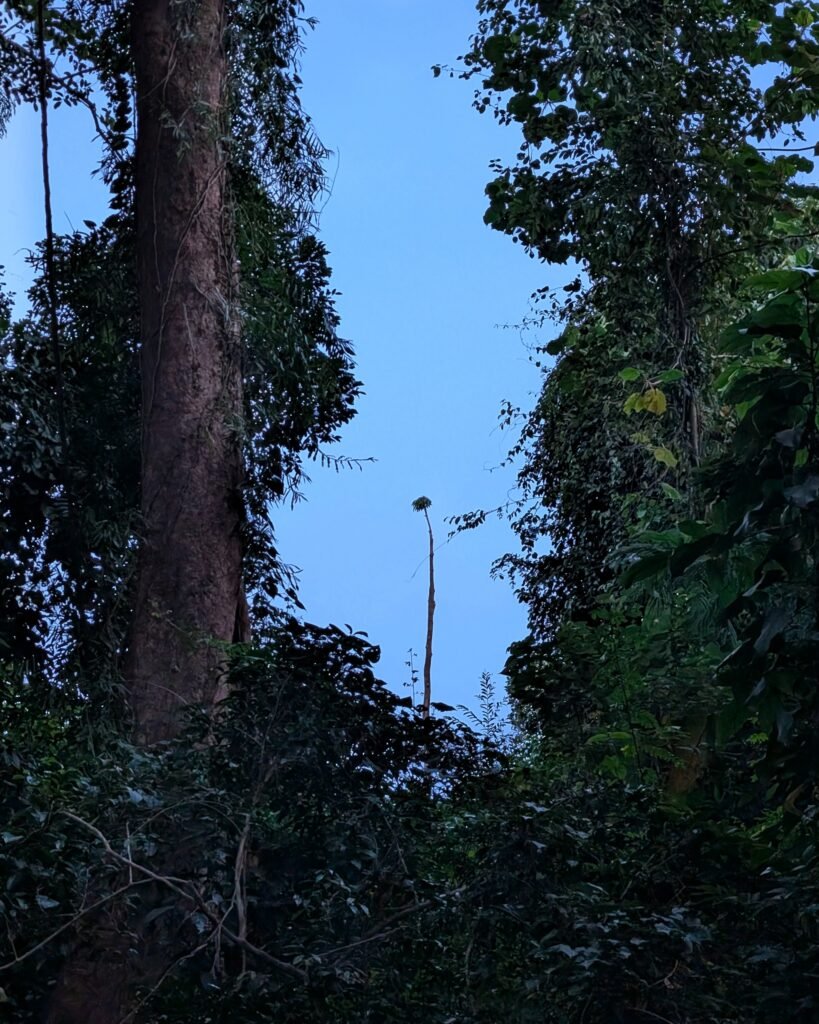
We had breakfast back at camp, which was again an absolutely delicious omelette, and were even offered some barbecued catfish that one of the rangers had caught in nets he had left in the stream overnight, before packing up to trek back to the edge of the jungle.
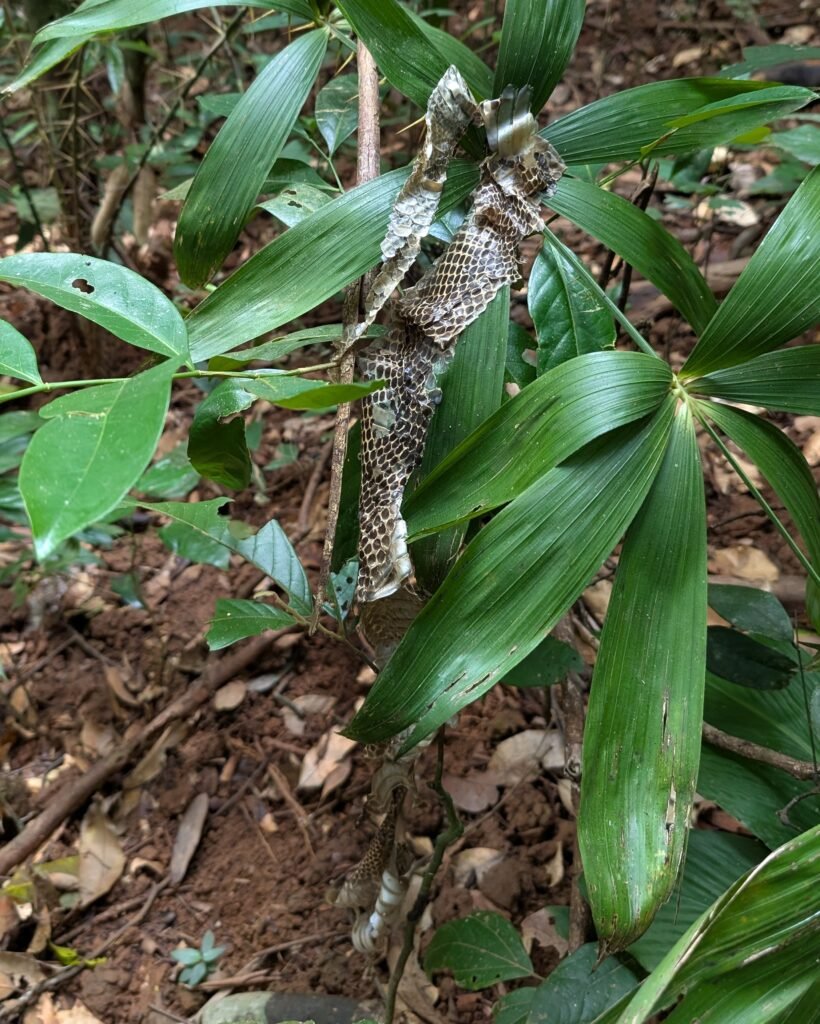
We took a different route the second day to see different parts of the jungle. We were lucky enough to see a bearded monkey on our way, and some other wildlife including the recently shed skin of what must have been a very large cobra (thankfully the snake itself was long gone). The trek was hard at times, which means you spend more time looking at the floor to avoid falling than admiring the beautiful scenery, but when we stopped we could appreciate the jungle for its true magnificence.
Our final bit of ‘adventure’ came towards the end of the second day’s trek. We arrived at the edge of the fast-flowing river and one of the guides said ‘this is where we change clothes to cross the river’. We thought he was joking, as they had made other similar jokes throughout the trek, but after they began stripping off, we realised they were serious. We had only thrown swimsuits into our bags last minute as we left our accommodation, and thank goodness we did, as we were told swimming in the river was an optional activity at camp, not an essential part of getting home!
The river was fast flowing, and it was a little nerve-wracking after next to no sleep and two days’ activity, but we managed to get across with the help of the guides and some makeshift bamboo walking sticks. This is not a gentle wade across the river, the water came up to above chest height for me (I’m 5 ft 5 in) and waist height for Christian (6 ft).
Once we’d crossed the river, we had a short trek back through bamboo forest and farmland to the bikes (where we almost encountered a wild boar, luckily our ranger reacted quickly to the growling from the bushes and urged us to go back a few metres and wait for it to pass). We then began the three hour journey back to Ban Lung.
Overall
Jungle trekking in Ratankiri is an incredible experience. There are few places you truly get to feel immersed in the jungle like this, and the guides and rangers are fantastic at making you feel safe. However, it’s worth noting that the experience truly is an adventure. You must make peace with the fact that you will be under attack by biting insects and leeches (and potentially other wildlife if you’re unlucky, it is the wild jungle after all), you may be trekking with no sleep, making unexpected detours including across rivers, be pushing your way through very thick undergrowth, climbing over rocks and logs, plus doing most of the above at night – this experience is not for the faint of heart!
Another reason we were a little disappointed with our experience is that besides the attempt to see the gibbons, there was little ‘point’ to the trekking beside the trek itself. Given how concentrated you must remain throughout, you don’t get much of a chance to enjoy the surroundings, and there was no end goal, viewpoint, or destination besides the camp. It’s worth noting that another popular route for these treks is to a waterfall where you can swim, admire the natural wonder, and sleep next to the babbling water. In hindsight, we would have preferred this, as it seems a more thought out, well-trodden route, as opposed to this one which is designed as more of a budget alternative to the gibbon experience in the conservation area.
Overall, our message is to go on the trek if you feel ready for an adventure (which hopefully, after reading this article, you do!), and to ask lots of questions at the tour company’s office so you know exactly what you’re in for. If you’re prepared and bring the right equipment, you’ll have an amazing adventure in the jungle in Ratanikiri!
TL;DR
Here’s what you should know before booking your jungle trek in Ratanikiri:
- The jungle trek is not just a trekking and camping trip – it is a serious ADVENTURE. Don’t go unless you’re prepared for any eventuality including being bitten by insects and leeches, pushing through thick undergrowth, running from beasts, and swimming across rivers;
- The journey to the jungle is long (three to four hours), consider this when deciding how long you want to spend in the jungle;
- Pack for all weather and terrain. A short packing list beyond a change of clothes would be:
- Warm layers to sleep in (nights in the jungle are cold!)
- a torch/ headtorch (even if you’re not told about a nighttime trek, there may well be one)
- swimming costume and towel (recreational swimming may be ‘optional’ but crossing the river may not be)
- bug spray (plenty of it)
- suncream
- In addition to the above, bring your own helmet if you’re nervous about clinging onto the back of a motorcycle through dirt ditches and wobbly bridges!
Leave a Reply